

California RCFE Licensure: Requirements, Application Checklist & Regulations
Summary
- Regulator: California Department of Social Services (CDSS) / Community Care Licensing Division (CCLD) under Title 22 and California Health & Safety Code.
- Administrator Rules: Must be 21+, complete an 80-hour Initial Certification course, pass the state exam (≥70%), pass background checks, and earn 40 Continuing Education (CE) hours every 2 years.
- Licensing Process: Step 1: Administrator Certification → Step 2: Component I Orientation → Step 3: LIC 200 Application & Fire Clearance → Step 4: Component II Analyst Interview → Step 5: Component III On-Site Inspection.
- Key Compliance Focus: Sufficient 24/7 staffing with CPR/First Aid coverage, person-centered evaluations, annual routine medical visit documentation, and updated safety features (slip-resistant flooring, 105°F–120°F water temp).
Opening a Residential Care Facility for the Elderly (RCFE) in California requires navigating a structured regulatory process managed by the California Department of Social Services (CDSS) and enforced by the Community Care Licensing Division (CCLD) under Title 22, Division 6, Chapter 8 and the California Health and Safety Code.
Whether you plan to open a 6-bed residential care home or a 100+ bed assisted living community, this guide outlines everything you need to know about Administrator certification, facility licensing, staffing compliance, and maintaining licensure in California.
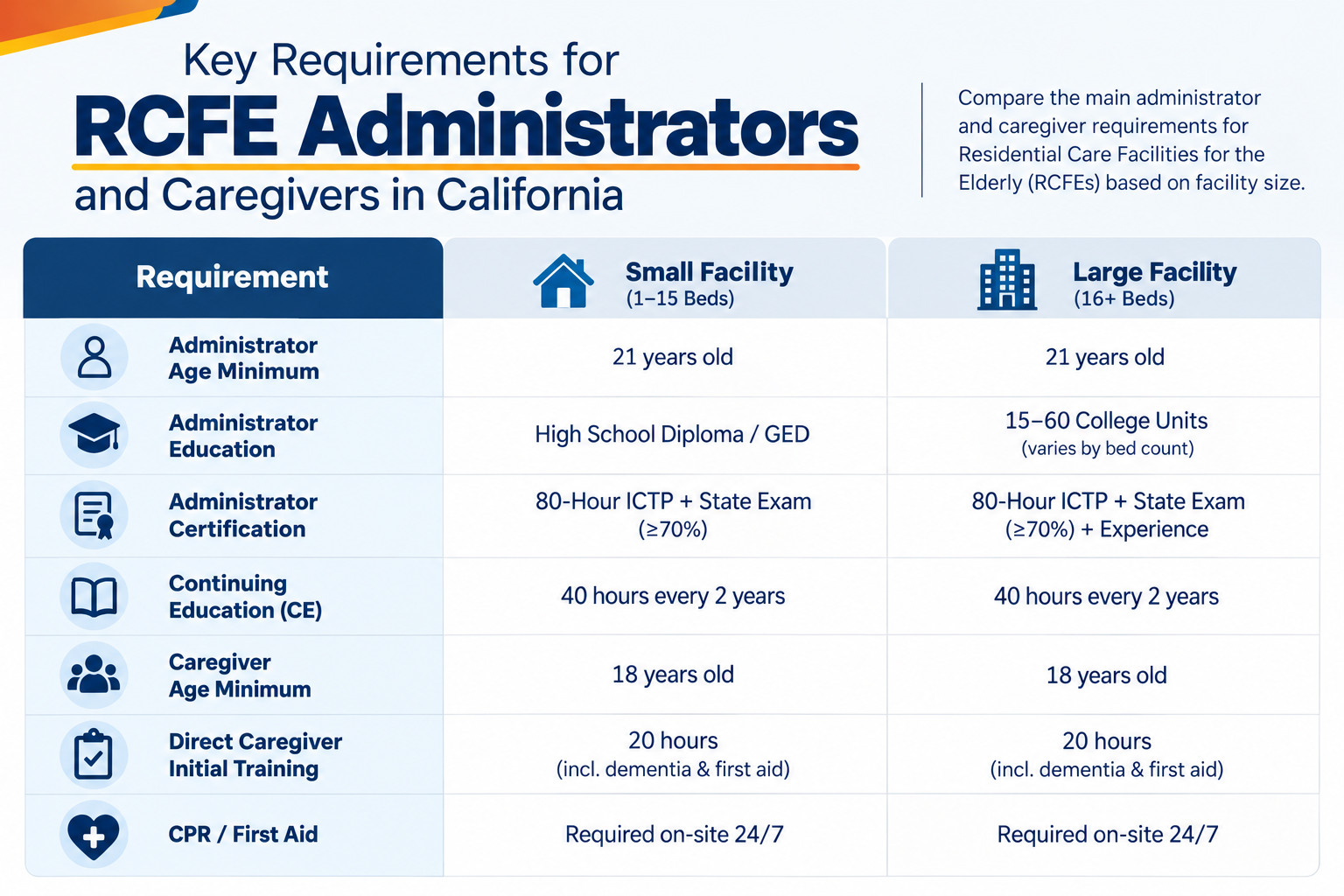
At a Glance: Key RCFE Requirements in California
| Requirement | Small Facility (1–15 Beds) | Large Facility (16+ Beds) |
|---|---|---|
| Administrator Age Minimum | 21 years old | 21 years old |
| Administrator Education | High School Diploma / GED | 15–60 College Units (varies by bed count) |
| Administrator Certification | 80-Hour ICTP + State Exam (≥70%) | 80-Hour ICTP + State Exam (≥70%) + Experience |
| Continuing Education (CE) | 40 hours every 2 years | 40 hours every 2 years |
| Caregiver Age Minimum | 18 years old | 18 years old |
| Direct Caregiver Initial Training | 20 hours (incl. dementia & first aid) | 20 hours (incl. dementia & first aid) |
| CPR / First Aid | Required on-site 24/7 | Required on-site 24/7 |
What is an RCFE License in California?
An RCFE (Residential Care Facility for the Elderly) license is a state-mandated authorization issued by the California Department of Social Services (CDSS) that allows a property or organization to provide housing, supervision, and non-medical care to adults aged 60 and older.
RCFEs provide support with Activities of Daily Living (ADLs)—including bathing, dressing, grooming, mobility, and medication management—for residents who do not require around-the-clock skilled nursing care.
The 6 Essential Steps to RCFE Licensure in California
1. RCFE Administrator Certification
Every RCFE must designate a certified Administrator responsible for daily operations, resident wellbeing, and regulatory compliance.
- Initial Certification Training Program (ICTP): Candidates must complete an 80-hour CDSS-approved ICTP, which consists of 60 hours of live instruction (in-person or live virtual) and 20 hours of self-paced instruction.
- State Examination: Within 60 days of course completion, candidates must pass the 100-question CDSS state exam with a score of 70% or higher.
- Application Submission: Submit the Administrator application, background clearance, and state fees to CDSS within 30 days of passing the exam.
- Administrator Education & Experience Prerequisites:
- 1–15 Beds: High school diploma or GED.
- 16–49 Beds: Minimum 15 college units + 1 year of eldercare experience.
- 50+ Beds: Minimum 60 college units (2 years) + 3 years of eldercare experience.
- Renewal: Certificates must be renewed every 2 years with 40 hours of Continuing Education (CE).
2. Mandatory Component I Orientation
Prior to submitting a facility application, prospective licensees must attend a 3-hour CDSS Component I Orientation specific to RCFEs. This orientation details state requirements, application compilation, and financial responsibility standards.
3. Facility License Application Submission
Applicants must submit a detailed LIC 200 Application for License along with a comprehensive Plan of Operation. Key requirements include:
- Proof of property ownership or an executed lease agreement with explicit RCFE consent.
- Detailed architectural floor plans showing resident rooms, bathrooms, and emergency exits.
- Financial solvency documentation (proof of operating capital to cover startup and emergency expenses).
- Local Fire Clearance approval (form LIC 850) obtained through the local fire authority.
- Criminal background clearance (Live Scan) for all owners, Administrators, and staff.
4. Component II Licensing Interview
After submitting the written application, a CCLD Licensing Program Analyst (LPA) conducts a one-on-one Component II Interview with the applicant. This interview verifies operational readiness, financial comprehension, and knowledge of Title 22 standards.
5. Component III On-Site Inspection & Survey
Before approval, the LPA conducts an on-site physical survey of the property. The facility must strictly comply with physical plant standards:
- Slip-Resistant Flooring: Flooring must meet modern safety standards (older “nonskid” wording updated).
- Water & Safety: Water temperatures set between 105°F and 120°F; swimming pools/water features secured with a minimum 5-foot fence and self-latching gate.
- First Aid & Emergency Supplies: Fully stocked medical and disaster preparedness kits on site.
- Medication Storage: Double-locked central medication storage.
6. Staffing Compliance and Caregiver Ratios
California Title 22 does not set a rigid numeric staff-to-resident ratio for general care. Instead, law mandates sufficient staff at all times to meet the specific physical, mental, and safety needs of the current census.
- Age Requirements: Administrators must be at least 21; direct care staff must be at least 18.
- 24/7 Coverage: At least one staff member certified in CPR and First Aid must be on duty and on the premises at all times.
- Caregiver Training: 20 hours of initial training before providing care (including 4 hours on dementia), plus 20 hours annually.
- Dementia Care Staff: 8 hours of dedicated dementia training prior to care, plus 8 hours of annual CE.
Interactive RCFE Licensure Progress Checklist
RCFE LICENSURE STEP-BY-STEP ROADMAP
PHASE 1: ADMINISTRATOR CERTIFICATION
PHASE 2: FACILITY & APPLICATION PREPARATION
PHASE 3: INTERVIEW & INSPECTION
PHASE 4: POST-LICENSURE & ONGOING COMPLIANCE
Essential Title 22 Compliance Updates
- Person-Centered Language & Individualized Evaluations: California regulations require person-first language in documentation. Providers must evaluate access to items (e.g., razors or cleaning supplies) individually rather than restricting access based solely on a diagnosis.
- Annual Routine Medical Visits & Reappraisals: Under Section 87463, RCFEs must perform documented reappraisals whenever a resident experiences a significant change in physical, mental, or functional status—and at least once every 12 months. Facilities must document an annual routine medical visit with a licensed medical professional for all residents.
- Infection Control & Disaster Plans: Modern Title 22 inspections focus heavily on facility-specific infection control protocols, emergency evacuation strategies, and backup power plans.
Frequently Asked Questions
An RCFE provides non-medical personal assistance, housing, and supervision with ADLs for seniors who do not require 24-hour nursing. A Skilled Nursing Facility (SNF) is a medical facility that provides 24/7 continuous skilled nursing care, medical treatments, and physical rehabilitation under medical supervision.
The RCFE licensing process typically takes 6 to 12 months. Timeline factors include completing the 80-hour Administrator training, passing local fire clearance inspections, submitting the LIC 200 application packet, and completing state interviews and facility surveys.
California law does not mandate a fixed numeric ratio for RCFEs. Title 22 requires “sufficient staff at all times” based on resident acuity. However, small 6-bed facilities typically maintain a 1:3 staff-to-resident ratio during waking hours, with at least one CPR/First Aid-certified staff member on site 24/7.
RCFE Administrators must complete 40 hours of continuing education (CE) every two years to maintain active certification with the CDSS.
Need Expert Help Opening or Operating an RCFE?
Navigating CDSS application forms, preparing a custom RCFE Plan of Operation, and completing administrator certification can feel overwhelming. Assisted Living Education offers premier RCFE Administrator Initial Certification Training Programs, continuing education courses, and full-service licensing consultation to streamline your approval process.
Disclaimer: The information in this article is for general educational purposes only and is not legal, medical, regulatory, or professional advice. Requirements and best practices may change, so readers should verify current information with the appropriate regulatory agency or qualified professional.

